01 · Tilt + turn
Tilt for air. Turn for access.
One handle moves the sash from secure top ventilation to a full inward opening.
Innotech's exclusive Ontario distributor
Many windows can post a respectable energy rating. Far fewer publish the NAFS ratings that show the stress test results.
See the engineering move
See how tilt + turn ventilation works and how a large lift + slide panel slides. Real demonstrations, reframed around the movement that matters.
Air leakage. Driven rain. Structural pressure. When energy values look close, NAFS helps show how strongly the complete window is built.
AW lifecycle testing asks a harder question: does the finished window still hold its performance after simulated use and temperature stress? Innotech's AW sequence tests air, water, pressure, and operation, cycles the unit, then repeats air-leakage, water-penetration, and operating-force checks to see what changed.
AW-PG85 / 90
AW-PG85 fixed · AW-PG90 tilt + turn85 and 90 psf equal 4.08 and 4.32 kPa. In plain terms: both published specimens reached the highest NAFS performance class.
294 and 302 km/h are simplified sea-level pressure equivalents derived from the published design pressures. They are not product wind-speed certifications. Project requirements depend on the site, building, unit size, glass, configuration, anchorage, and installation.
Hotels, universities, multi-storey housing and coastal resorts prove the engineering at scale. Haven Haus brings that same discipline into a window package designed for the house.


A low U-value matters on day one. Heavy-duty frames, multi-point hardware, welded corners, and repeat weather testing are what help the window stay tight and operate smoothly through years of use.
Start with 76TS for practical high performance. Step up to 88PH+ when Passive House certification, the site or the envelope target gives you a reason.
Compare the Defender systems
Both are made by Innotech. The difference is how far the energy brief needs to go. Open either system for the practical distinction.
Most Ontario homes
High-rise-grade durability without over-specifying the project.
The system most Haven Haus clients choose: strong NAFS performance, tilt + turn operation, and double- or triple-glazing flexibility at a mainstream project price.
Innotech 76TS NAFS summary, 2026-06-19. Published snapshots; the exact grade varies by operator, tested size, and configuration.
Certification-led projects
When Passive House certification or the coldest sites set the brief.
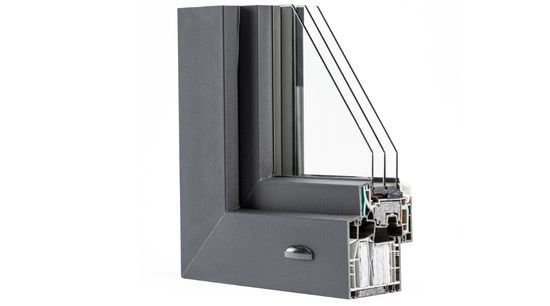
88PH+ Pro covers cool-temperate Passive House targets; 88PH+ XI is certified for cold climates. Both use an insulated 88 mm frame and triple glazing.
Innotech 88PH+ NAFS summary, 2026-06-18. Published snapshots; the exact grade varies by operator, tested size, and configuration.
●Most homes start with the 76TS. Certification or the coldest sites step up to the 88PH+.
The system most Haven Haus clients choose: strong NAFS performance, tilt + turn operation, and double- or triple-glazing flexibility at a mainstream project price.
Virtual showroom
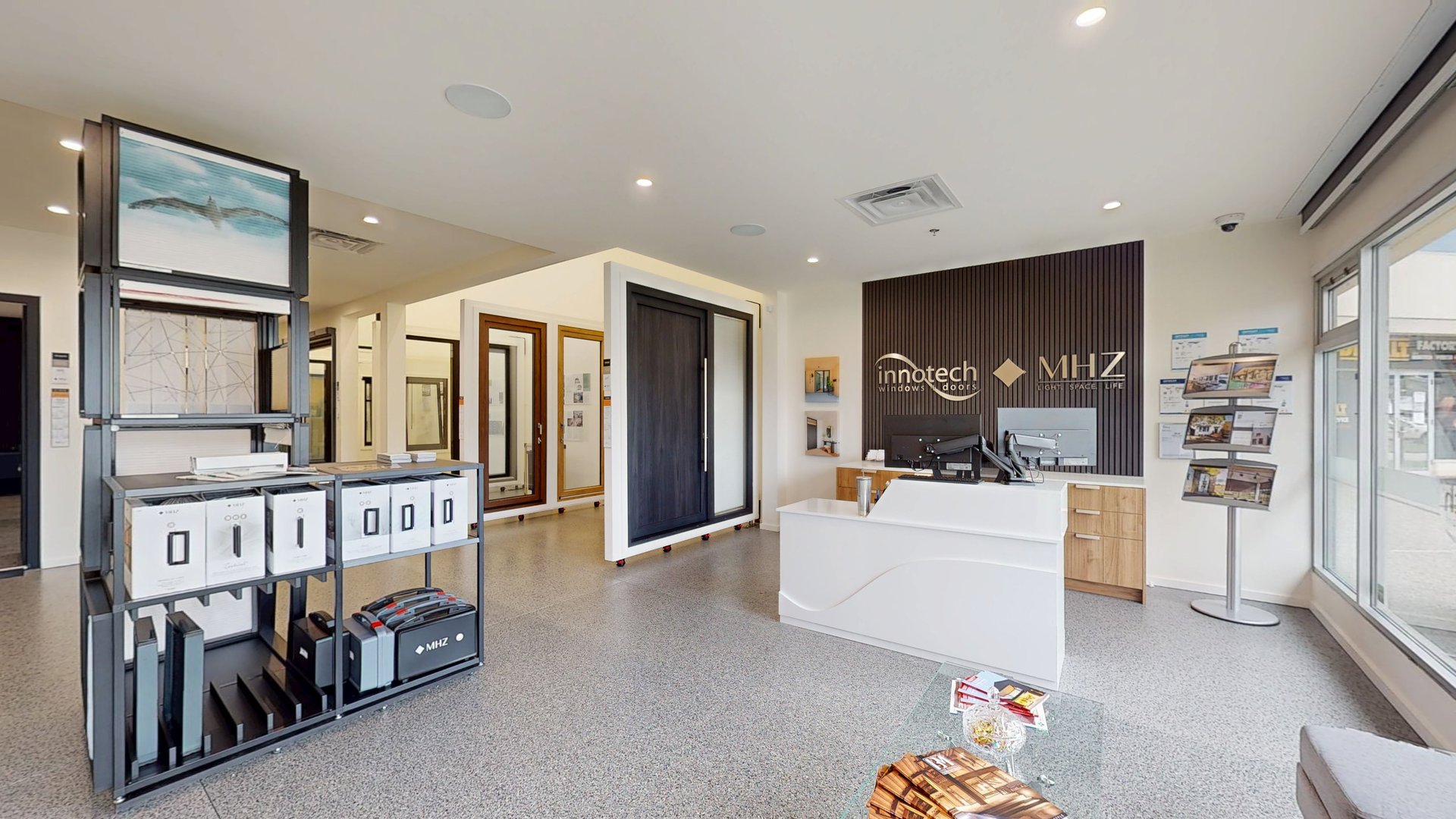
Move through the Innotech Design Centre, inspect sightlines, and compare window and door configurations from room to room. The interactive tour loads only when you choose to enter it.
Open any system for its measured details. Tap it again to minimize.
Scroll sideways for all systems →
| Metric | Defender 76TS | Defender 88PH+ Pro | Defender 88PH+ XI |
|---|---|---|---|
| Thermal transmittance (Uw, W/m²K)Heat lost through the whole window — lower is better. | 0.80–1.20 | 0.74–0.86 | 0.69–0.80 certified 0.59 fixed / 0.60 operable |
| Passive House InstitutePHI certifies by climate zone. The cold zone covers harsh Canadian climates; few systems made in North America qualify. | Net-Zero Energy Ready Frequently specified for Passive House projects not pursuing certification | Certified — cool-temperate (phA fixed / phB operable / phC terrace door) | Certified — cold climate, class phA #1793 / #2030 |
| Airtightness (tested)No measurable air leakage through the assembly at test pressure. | 0.00 CFM/ft² | 0.00 CFM/ft² | 0.00 CFM/ft² |
| NAFS class + gradeRead class, grade, operator, and tested size together. PG is not a pressure-only claim. | AW-PG85 fixed 59 × 98 in AW-PG90 tilt + turn 47 × 71 in | AW-PG85 fixed 59 × 98 in AW-PG90 tilt + turn 47 × 71 in | AW-PG85 fixed 59 × 98 in AW-PG90 tilt + turn 47 × 71 in |
| Water resistanceThe specimen is sprayed while a test chamber maintains pressure. Higher pressure is a harder test. | 15 psf 720 Pa | 15 psf 720 Pa | 15 psf 720 Pa |
| Solar heat gain coefficient (SHGC)Fraction of solar heat admitted. Higher can support winter gain; lower can reduce summer overheating. Orientation matters. | 0.17–0.50 | 0.15–0.40 | 0.15–0.41 |
| Glazing | Double or triple | 46 mm triple | 46 mm triple |
| Frame | 76 mm uPVC + steel hybrid | 88 mm hybrid, insulated core | 88 mm hybrid, insulated core |
| Best for | Everyday high-performance builds | Passive House & net-zero projects | The coldest sites and the strictest energy targets |
Sources: Innotech current product data and June 2026 NAFS performance summaries; Passive House Institute component database. NAFS and certified thermal values are configuration-specific.
Numbers first. Now see them in a room.
Explore residential, hospitality, institutional, and waterfront projects featuring Defender systems.
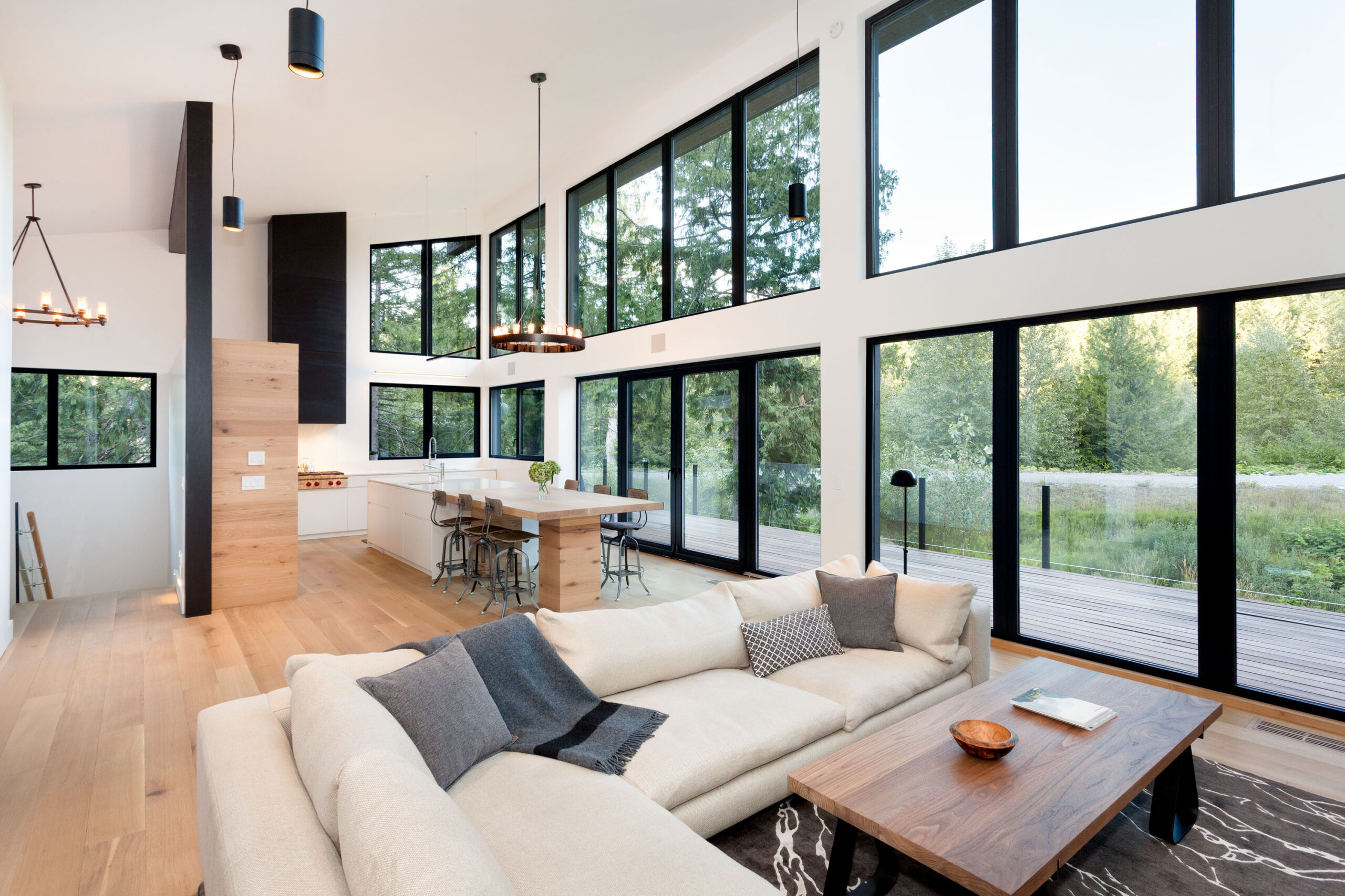
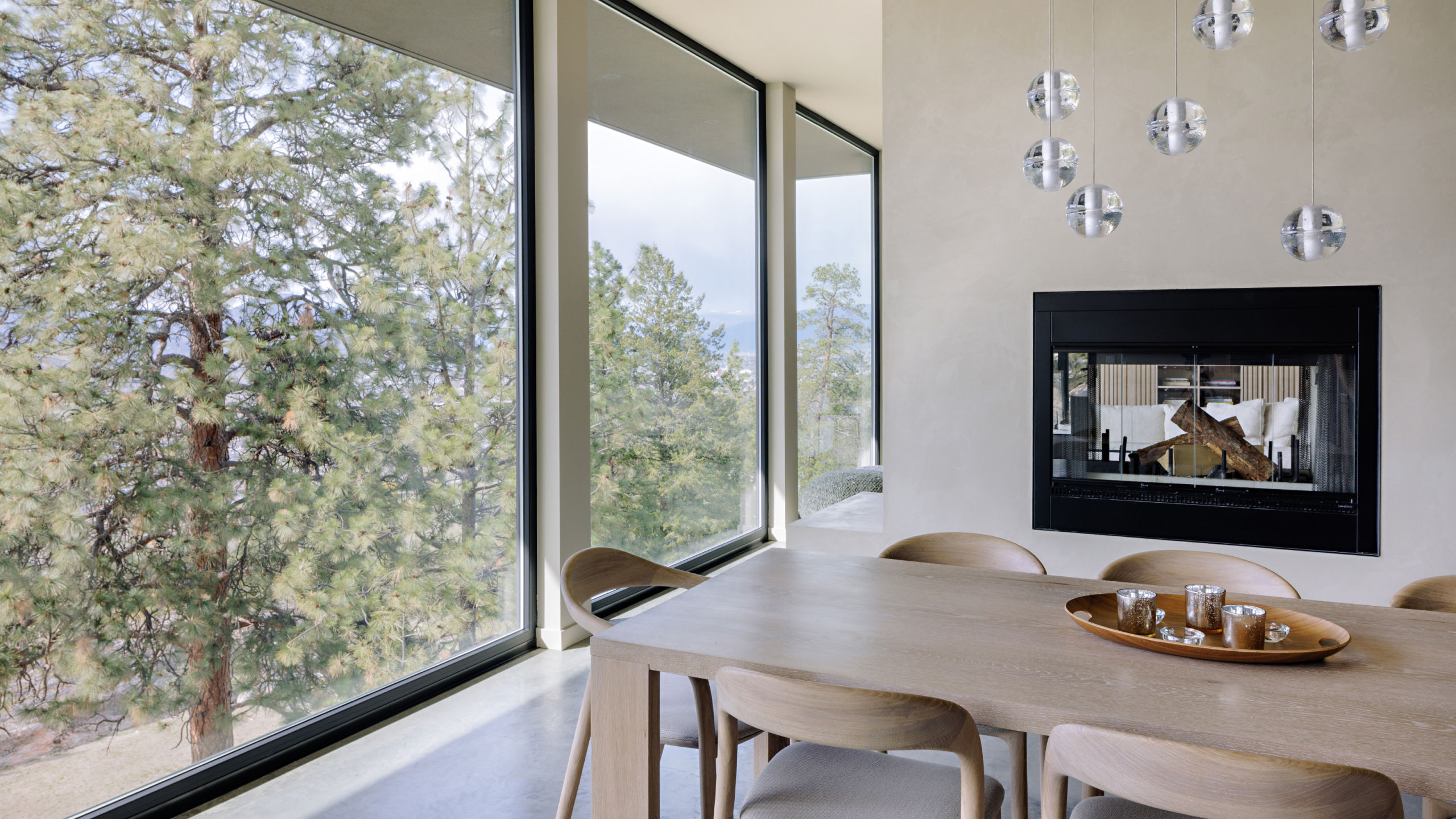
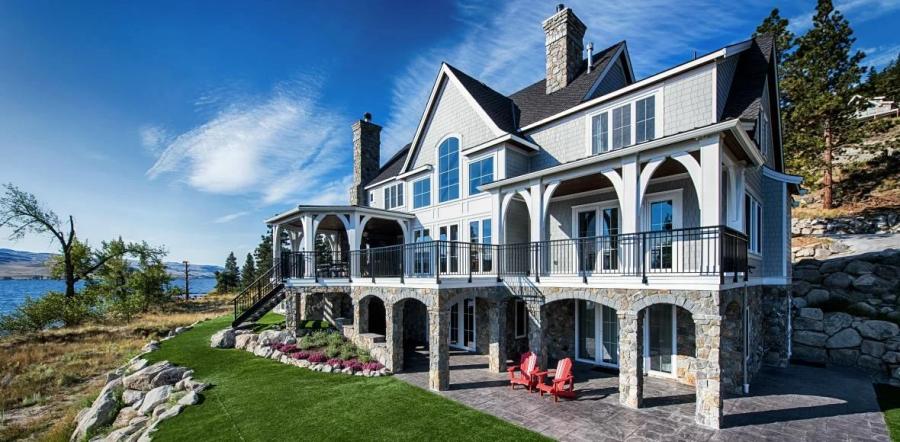
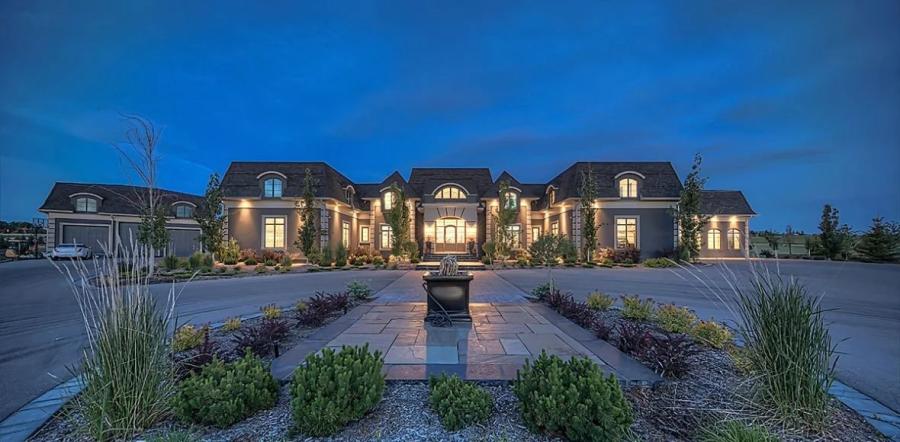
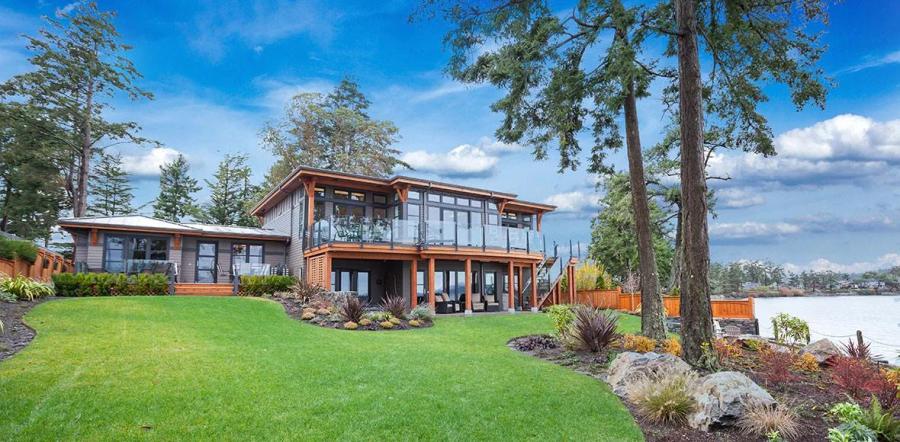
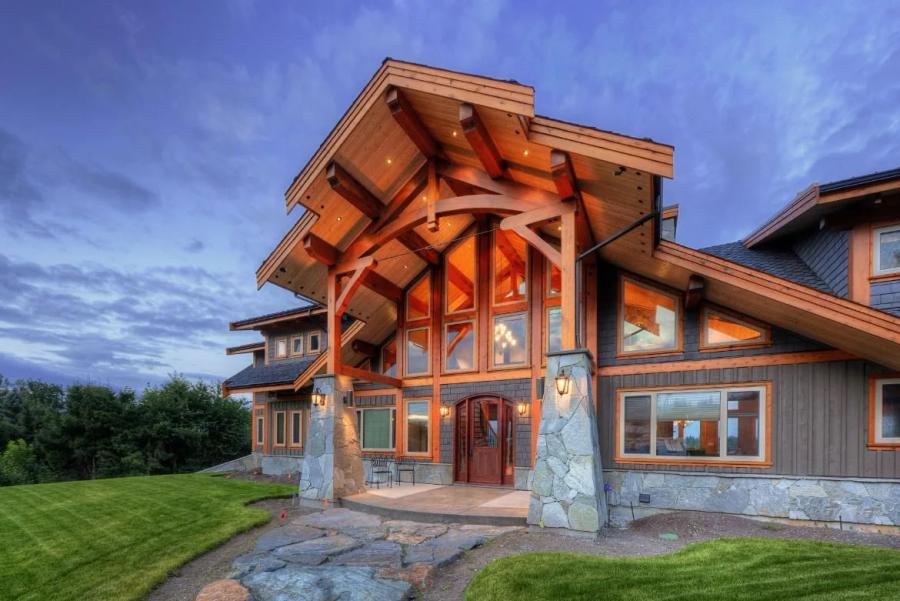
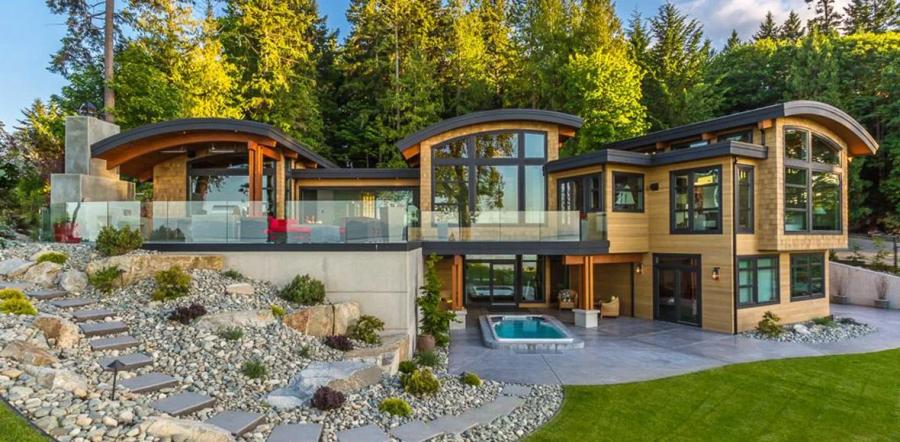
Five houses, five architectural settings, one practical question: what will the windows look like in mine?
 Residential focus
Cottage
 Residential · 02
Estate
 Residential · 03
Coastal residence
 Residential · 04
Country residence
 Residential · 05
Contemporary residence
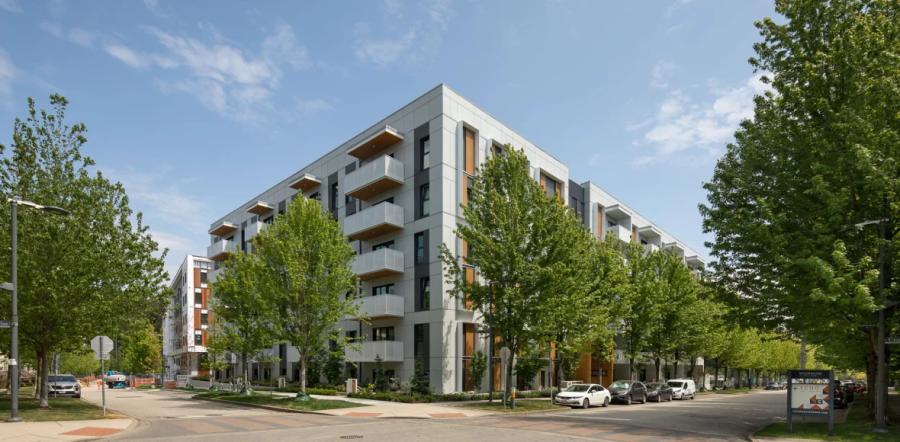
Defender systems across multi-storey housing, institutional buildings, hospitality, and exposed sites.
 Multi-storey
Multi-storey residential
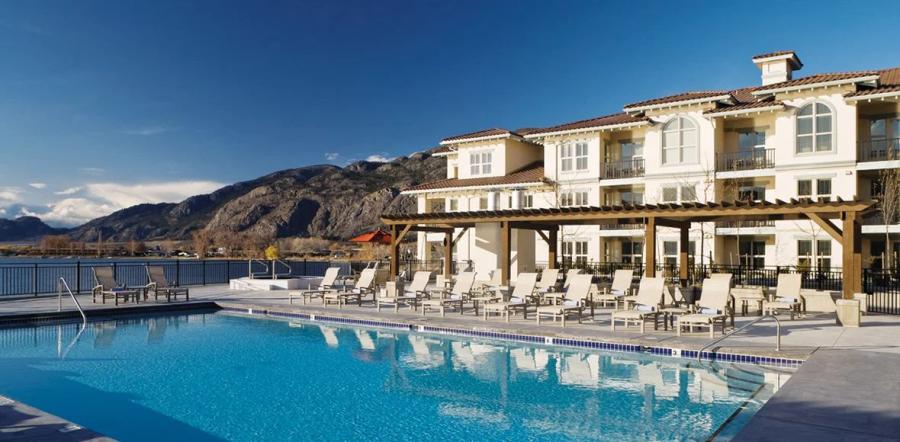 Hospitality
Resort
 Institutional
Monastery
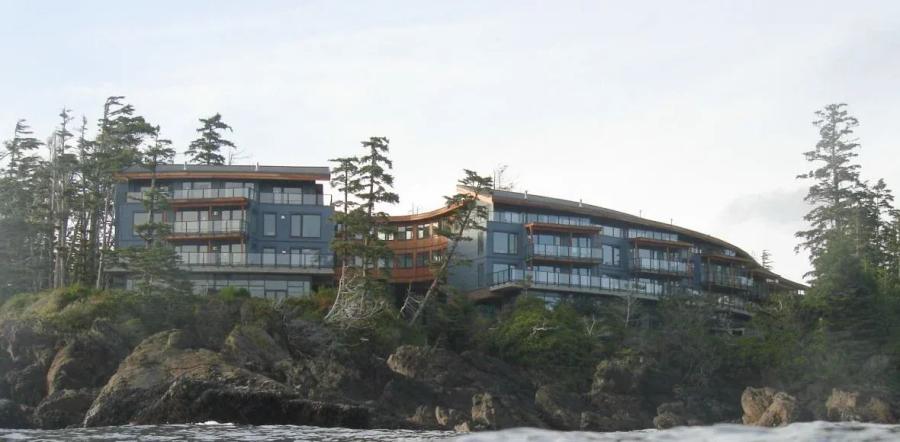
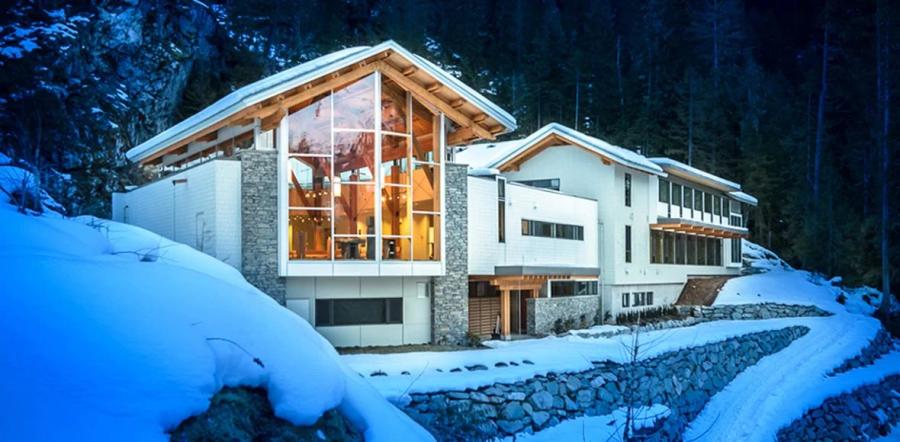
Black Rock Oceanfront Resort shows a Defender system in a hospitality project with oceanfront exposure.
Black Rock Oceanfront Resort · Innotech projectThe certified 88PH+ XI proves the ceiling. The practical 76TS comes from the same manufacturer and testing culture.
The Defender 88PH+ XI is one of only a handful of cold-climate-certified window systems manufactured in North America — certified by the Passive House Institute at efficiency class phA.
Source: PHI component database, certs #1793 / #2030
No measurable air leakage through the assembly at test pressure.
0.00 CFM/ft²
Window styles compared
Choose another style, then compare both columns across the same eight criteria.
Scroll sideways for all styles →
| Criterion | Tilt + Turn | Slider | Single/Double Hung | Casement | Awning |
|---|---|---|---|---|---|
| Opening mechanism | ExcellentDual-action: tilts inward from top or opens fully like a door | GoodHorizontal sliding sash(es) | GoodVertical sliding sash(es) | GoodSide-hinged, opens outward with a crank | GoodTop-hinged, opens outward with a crank |
| Seal quality | ExcellentMulti-point compression seals on all sides | PoorFriction seals only, no compression | PoorFriction seals only, no compression | GoodCompression seal on three sides, weaker at hinge side | GoodCompression seal on three sides, weaker at hinge side |
| Security | ExcellentMulti-point locking system around entire perimeter | PoorBasic locks at meeting stile only | PoorBasic locks at meeting rail only | GoodMulti-point locking on one side only | GoodMulti-point locking on bottom edge |
| Ease of cleaning | ExcellentTurn mode allows full access to both sides from interior | FairSome models remove for cleaning, others require exterior access | FairSome models tilt in for cleaning, others require exterior access | PoorExterior cleaning requires reaching outside | PoorExterior cleaning requires reaching outside |
| Maintenance | ExcellentHigh-quality hardware with minimal maintenance required | FairTracks collect debris and require regular cleaning | FairBalance systems may fail over time | GoodHinges and crank mechanisms may require maintenance | GoodHinges and crank mechanisms may require maintenance |
| Noise reduction | ExcellentSuperior compression seals provide excellent sound insulation | PoorLimited sound insulation due to friction seals | PoorLimited sound insulation due to friction seals | GoodGood sound insulation with proper seals | GoodGood sound insulation with proper seals |
| Energy efficiency | ExcellentBest-in-class thermal performance with tight seals | PoorLower thermal performance due to air leakage | PoorLower thermal performance due to air leakage | GoodGood thermal performance with compression seals | GoodGood thermal performance with compression seals |
| Weather resistance | ExcellentExceptional resistance to air and water infiltration | PoorLower resistance to air and water infiltration | FairModerate resistance to air and water infiltration | GoodGood resistance to air and water infiltration | ExcellentExcellent resistance to water infiltration |
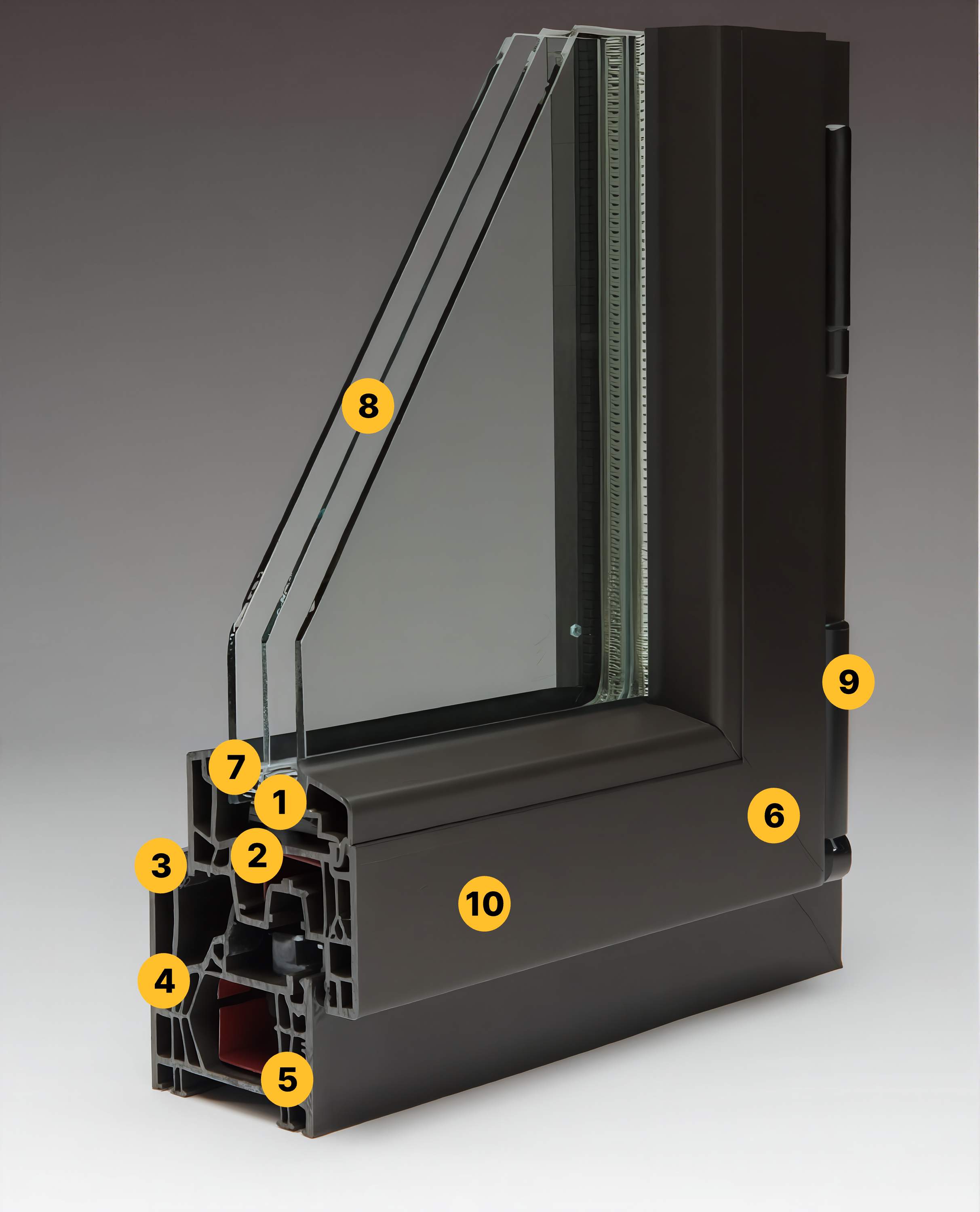
Window anatomy
The parts you never see are the reason the numbers hold. Cross-section, component by component.
Security, by mechanism
No scare copy. Just the hardware, glass and frame construction that determine how a window closes and holds.
Tilt+turn engineering, manufactured in British Columbia.
Impact test video · poster pending
A band of steel hardware bolts to the frame at multiple points, distributing engagement beyond a single latch.
The tilt position provides top-edge ventilation. Available controls include restrictors, a tilt-before-turn keyed lockable handle and a custodial lock.
Laminated glass is documented as an available glazing option. The current inventory does not assign it a named security rating.
Defender 76TS uses galvanized steel reinforcement within unplasticized (uPVC) profiles. Defender 88PH+ instead uses a foam-core hybrid frame with fiberglass-reinforced sashes.
Source: current Innotech product documentation, 2026-07-22. Security options vary by product and configuration.
The two ratings, in plain language
NFRC measures energy performance: heat transfer, solar heat gain, and visible light under standardized conditions. NAFS tests the complete window for air leakage, water penetration, and structural load before it receives a class and grade. At the premium tier, the combination matters. Current Innotech results put the Defender 76TS fixed and tilt + turn specimens in AW at PG85 and PG90—subject to operator, tested size, and configuration.
NAFS, the North American Fenestration Standard, evaluates the complete window, not just the glass. Applicable tests cover air leakage, water penetration resistance, and structural loading before the product receives a class—R, LC, CW, or AW—and a performance grade. Read that result with the operator type and tested specimen size.
NFRC ratings describe energy performance, including U-factor, solar heat gain, and visible transmittance. NAFS describes how the complete unit performed under specified air, water, structural, and class-dependent tests. One is not a substitute for the other: compare both efficiency and the configuration-specific NAFS designator.
AW, or Architectural, is the most demanding NAFS performance class. It is intended for increased loads, tighter deflection limits, and frequent or extreme use; its sequence also adds thermal cycling and post-cycle checks. Current published Defender 76TS specimens reached AW-PG85 fixed and AW-PG90 tilt + turn. The designation applies to the tested operator, size, and configuration.
Not by itself. A lower U-factor generally means less heat transfer, but the project also needs the right solar heat gain, visible light, glazing, orientation, and climate fit. Once the energy targets are met, compare the whole window's NAFS class and grade, tested size, operator, installation requirements, and certification evidence. One number cannot summarize the complete decision.
NAFS classes compared
Class and grade answer different questions. Class says how demanding the test program is. PG says the pressure level this specific operator, size, and configuration passed. A higher PG does not erase a lower class.
| Class | Gateway | Common fit | What changes |
|---|---|---|---|
| AW Architectural | PG40 minimum 40 psf · 1.92 kPa Water basis: 20% of DP | Mid- and high-rise work, increased loads, tighter deflection control, and frequent or extreme use. | AW durability sequence. AW adds thermal life-cycle stress and post-cycle rechecks. |
Technical Innotech describes thermal life-cycle testing as unique to AW. After temperature cycling, the same specimen repeats air-leakage, water-penetration, and operating-force checks. Its AW program also includes static and cyclic water, uniform load structural, forced entry, operating cycles, hardware load, sash or leaf torsion, and deflection testing. Plain language AW asks a second question: after the finished window has been stressed, did its seals, hardware, and operation still hold up? Compare carefully AW is not a blanket rating for every size. Match the operator, tested specimen, options, NAFS edition, label, and report to the supplied unit. | |||
| CW Commercial | PG30 minimum 30 psf · 1.44 kPa Water basis: 15% of DP | Low- and mid-rise work with larger openings, higher loading, deflection limits, and heavier use. | Commercial loading and use. Stronger gateway demands than LC, without AW's thermal life-cycle sequence. |
Technical CW starts at PG30 and commonly addresses larger minimum gateway specimens, higher loading, deflection control, and heavier use. Its water-test basis is 15% of design pressure, subject to the applicable jurisdictional cap. Plain language CW is built for larger, harder-working windows than the lower classes, but it does not include AW's thermal stress and repeat-check sequence. Compare carefully A CW-PG80 has a higher pressure number than AW-PG40, but the class test scopes differ. Compare both letters and number. | |||
| LC Light commercial | PG25 minimum 25 psf · 1.20 kPa Water basis: 15% of DP | Low- and mid-rise multifamily or light-commercial work where larger sizes and loads are expected. | A bridge above residential. More demanding than R, but below CW for loading, deflection, and heavy-use expectations. |
Technical LC starts at PG25. NAFS-22 added alternative minimum test sizes for selected LC products when the smaller gateway is paired with higher performance requirements, so operator type and standard edition matter. Plain language LC is the middle step for larger residential and lighter commercial work. It raises the bar without claiming the full CW or AW test scope. Compare carefully The class name is a guide, not a building prescription. The project authority, architect, or engineer determines the required class, grade, and secondary designators. | |||
| R Residential | PG15 minimum 15 psf · 0.72 kPa Water minimum: 2.9 psf · 140 Pa | Commonly used in one- and two-family dwellings. | The residential gateway. A valid class for many homes, with lower gateway demands than LC, CW, or AW. |
Technical R starts at PG15. Water testing starts at 2.9 psf or 140 Pa. NAFS-22 removed a universal R minimum gateway size, so the tested operator, actual specimen, edition, and rating label are essential context. Plain language R does not mean bad or non-compliant. It means the product entered through the residential class requirements rather than the broader commercial or architectural programs. Compare carefully An R product with a high PG can resist substantial pressure, but the number alone does not upgrade its class or add AW durability testing. | |||
Published test snapshots
These are published laboratory results, not blanket ratings for every possible size or configuration.
| Published test | Defender 76TS | Defender 88PH+ Pro / XI | Easy takeaway |
|---|---|---|---|
| Air leakage | 0.00 CFM/ft² | 0.00 CFM/ft² | No measurable leakage at the report's published precision. Installation still matters. |
| Water resistance | 15 psf 720 Pa | 15 psf 720 Pa | The specimen resisted spray while the lab chamber held this pressure. It is not a rainfall-volume claim. |
| Fixed window | AW-PG85 85.2 psf · 4.08 kPa 59 × 98 in tested | AW-PG85 85 psf · 4.08 kPa 59 × 98 in tested | Approximately 294 km/h as a simplified pressure equivalence. Read the caveat below. |
| Tilt + turn | AW-PG90 90.2 psf · 4.32 kPa 47 × 71 in tested | AW-PG90 90 psf · 4.32 kPa 47 × 71 in tested | Approximately 302 km/h as a simplified pressure equivalence. Operator type changes the rating. |
| Large-format examples | CW-PG45 fixed 92 × 120 in tested CW class · PG60 fixed + operable 60 × 120 in tested | CW class · PG60 fixed 86.6 × 10² in tested CW-PG80 tilt + turn 59 × 98.4 in tested | The same system can carry a different grade at a different size or assembly. Compare the exact specimen. |
Wind comparison: 4.08 and 4.32 kPa are approximately equal to the idealized sea-level dynamic pressure of 294 and 302 km/h airflow. This is a pressure equivalence, not a wind-speed certification. Project loads still depend on height, exposure, terrain, building shape, installation, glass, size, and configuration.
How to read the proof
Fixed and tilt + turn units can earn different grades.
A larger specimen can carry a different grade from a smaller one.
PG means the design pressure plus applicable air, water, structural, and class requirements.
Match the supplied unit to its configuration-specific label or test report.
Where an AAMA Gold Label is supplied, the certification route adds independent laboratory testing and two unannounced plant inspections each year. Confirm the label: a NAFS-tested claim alone does not establish that specific certification route.
Sources: FGIA performance-class guidance; FGIA water-test overview; current Innotech 76TS data; current Innotech 88PH+ data; Innotech AW certification update, 2025-09-10; June 2026 Innotech NAFS summaries for configuration detail. Edition note: the 2025 National Building Code of Canada references NAFS-22; NAFS-26 is published and proposed for a future NBC mid-cycle update.
See the full hierarchy first. Open a row only when you want the detail.
Scroll sideways for details →
| Certification | What it means | Our system |
|---|---|---|
| Cold Climate Passive House (PHI)Elite | The most demanding certification for extreme climates — measured airtightness, thermal efficiency, and durability in the cold zone. Only a handful of cold-climate-certified window systems are manufactured in North America; the Defender 88PH+ XI is one of them (PHI certs #1793/#2030). | Defender 88PH+ XI |
| Passive House (PHI)Gold | The gold standard for energy performance: airtight, thermally efficient buildings with rigorous testing and verification requirements. | Defender 88PH+ Pro |
| Net-Zero Energy Ready / NEC Tier 4Building target | A whole-home energy target and the national code's top tier. It sets the performance bar for the complete building envelope. | Defender 76TS |
| National Energy Code Tier 3Silver | Ontario's 2025 requirement for new homes; a significant step up from previous building code. | |
| National Energy Code Tier 2Higher | Moderate energy-performance improvements; not currently adopted in Ontario. | |
| LEED / Built GreenBuilding programs | Whole-building programs with multiple certification levels. The window package is one part of the overall project score. | |
| NEC Tier 1 / Ontario 2025 StandardBaseline | Ontario's current standard as of 2025; the minimum National Energy Code requirement. |
Sources: Haven Haus energy-standards guide; Passive House Institute component database.
Reading a window rating
Every mark on a window spec answers a different question. Here is what each one actually measures — and what to look for when a quote puts a number in front of you.
It grades the whole window against wind, water, and air — in one specific tested configuration.
Example: Defender 76TS tilt + turn — AW-PG90, tested at 47.2″ W × 70.9″ H.
Full guideHow fast heat escapes through the whole window — frame and glass together. Lower means less heat lost.
Published NFRC U-factor ranges88PH+ XI fixed · 0.12–0.14 IP (0.69–0.80 SI)76TS triple tilt+turn · 0.16–0.21 IP (0.92–1.20 SI)
Full guideA government-backed efficiency mark — a threshold a product either meets or does not, not a ranking.
The Passive House Institute certifies the component itself — for a named climate zone, with an efficiency class and a whole-window Uw.
Defender 88PH+ XI fixedUw 0.59 W/(m²K) · class phA · Cold climateCertified since April 27, 2021 · component 1702fx02
Full guidePerformance data
Current Innotech manufacturer data, configuration-labeled. Every structural rating below names class, performance grade, operator type, and tested size. Tilt+turn engineering, manufactured in British Columbia.
Pressure analogy
~294 / 302 km/hEquivalent dynamic pressure at the PG85/PG90 structural load. Analogy only, not a wind-speed rating.
88PH+ Pro · cool, temperate
Three PHI-certified component configurations, fixed, tilt+turn and terrace door.
0.75–0.79Uw W/(m²K) · certificate range88PH+ XI · cold
Two PHI cold-zone, phA components, one fixed and one operable.
0.59–0.60Uw W/(m²K) · certificate range| System | Operator | NAFS class / PG | Tested size | Air infiltration | Water resistance | Wind load |
|---|---|---|---|---|---|---|
| Defender 76TS | Fixed | AW-PG85 | 59″W × 98.4″H | 0.00 CFM/FT² | 15 PSF | 85 PSF |
| Defender 76TS | Tilt+Turn | AW-PG90 | 47.2″W × 70.9″H | 0.00 CFM/FT² | 15 PSF | 90 PSF |
| Defender 88PH+ | Fixed | AW-PG85 | 59″W × 98.4″H | 0.00 CFM/FT² | 15 PSF | 85 PSF |
| Defender 88PH+ | Tilt+Turn | AW-PG90 | 47.2″W × 70.9″H | 0.00 CFM/FT² | 15 PSF | 90 PSF |
| Tier | Operator | Uw W/m²K | Uw, installed | Temperature factor | PHI class |
|---|---|---|---|---|---|
| 88PH+ Pro | Fixed / Tilt+Turn | 0.75–0.77 | 0.76–0.78 | — | — |
| 88PH+ XI | Fixed | 0.59 | 0.60 | 0.77 | phA |
| 88PH+ XI | Tilt+Turn | 0.60 | 0.64 | 0.78 | phA |
The 0.59 W/m²K value is XI-only; Pro does not reach it. The 88PH+ XI is the first Passive House Institute cold climate certified window system manufactured in North America, and the first uPVC Passive House Institute cold climate certified window system manufactured in the world (Innotech blog, accessed 2026-07-22).
| System | Glazing | Operator | U-factor IP (SI) | SHGC |
|---|---|---|---|---|
| Defender 76TS | Double | Fixed | 0.21–0.24 (1.20–1.55) | 0.21–0.50 |
| Defender 76TS | Double | Tilt+Turn | 0.22–0.27 (1.25–1.55) | 0.19–0.44 |
| Defender 76TS | Triple | Fixed | 0.15–0.20 (0.86–1.14) | 0.19–0.43 |
| Defender 76TS | Triple | Tilt+Turn | 0.16–0.21 (0.92–1.20) | 0.17–0.38 |
| Defender 88PH+ Pro | Triple | Fixed | 0.13–0.14 (0.74–0.80) | 0.17–0.40 |
| Defender 88PH+ Pro | Triple | Tilt+Turn | 0.13–0.15 (0.74–0.86) | 0.15–0.35 |
| Defender 88PH+ XI | Triple | Fixed | 0.12–0.14 (0.69–0.80) | 0.15–0.41 |
| Defender 88PH+ XI | Triple | Tilt+Turn | 0.12–0.14 (0.69–0.80) | 0.15–0.35 |
88PH+ fixed SHGC is listed by Innotech as two overlapping ranges (0.17–0.40 / 0.15–0.41) without explicit Pro/XI assignment; the table assigns them by tier for configuration clarity. Tilt+Turn SHGC is 0.15–0.35 for both tiers per current data.
Configure
Ten decisions, made together in order — from the system series to the handle in your hand.
Glass by elevation
In an Ontario heating-dominated climate, orientation changes the tradeoff between useful winter gain, summer comfort and glare. Start with the elevation, then tune the full glazing build for the room.
With little direct sun, the higher-solar-gain option is often the useful starting point. The complete unit still needs to meet the project’s heat-loss target.
Morning sun is easier to manage than late-day heat. A balanced coating often keeps useful light while tempering solar gain.
LoĒ-180 can support passive winter gain; LoĒ-270 is the more balanced starting point where glazing area, overhangs or summer comfort call for added control.
Low afternoon sun can drive glare and overheating. The stronger solar-control option is often the first one to test here.
What the numbers show
Published solar heat gain coefficients depend on double vs triple glass and fixed vs tilt+turn — configuration first, coating second.
Coating choice is confirmed in consultation with the window size, room use, exterior shading and the project’s energy target.
Bring the floor plan — orientation by room is where this gets useful.
Cardinal LoĒ-180, LoĒ-270 and LoĒ-366 are published options for Defender 76TS and 88PH+ systems. Tilt+turn engineering, manufactured in British Columbia.
WARRANTY
Frames are covered for 35 years. The warranty transfers to the next owner — for up to 20 years from installation. Tilt+turn engineering, manufactured in British Columbia.
35 yearsProduct frames — the structure of the window
TransfersTo the next owner, up to 20 years from installation
On “lifetime” warranties:in Canada, unqualified lifetime warranty language is legally meaningless (Office of Consumer Affairs guidance). Every component and term is set out in the manufacturer’s warranty document below — not behind a “lifetime” promise.
Source PDF: INNOTECH-WINDOWS-DOORS-35-Year-Transferable-Warranty-LU03-26.pdf · Lift + Slide uses a separate 10-year non-transferable warranty
From quote to installed
Tilt+turn engineering, manufactured in British Columbia — then fitted into an Ontario home. Below is the dealer process skeleton we walk clients through. Exact sequence is confirmed for each project.
Walk the home, clarify goals (comfort, sound, certification path, aesthetics), and identify which openings need replace versus repair attention.
Openings are measured for the specified operators and glass packages so the factory builds to the opening — not the other way around.
Units are built to order in British Columbia. Configuration, hardware, and glazing are fixed before production begins.
Existing units come out, new frames go in, and the work area is protected. Access, parking, and pets are coordinated in advance.
Handles, tilt/turn, and locking are demonstrated. Care expectations and warranty registration steps are reviewed before the crew leaves.
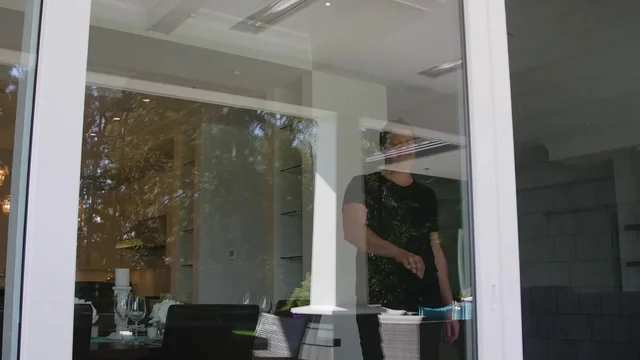
Bring your plans or an existing quote. We will help identify the product, measurement and installation questions that still need answers.
Process skeleton for dealer walkthrough · install media from Innotech Windows + Doors official channel
Manufacturer care guidance: check hardware and gaskets at least twice a year — more often for coastal installations near saltwater — to keep warranty coverage in good standing.
Diagnose before you replace
Not every draft or drip means a full replacement. Use this as a second-opinion checklist — then bring a quote or a photo set if you want a careful read on the openings that matter.
Air moves where seals, frames, or installation leave a path. Often worse on windward elevations and older single-latch windows.
Gasket wear, warped sash, or an assembly that never sealed tight. Repair can help if the frame is sound; widespread leakage across many openings often points to replace.
The signal: if resealing and adjustment do not hold, the draft is the unit, and the repair money starts chasing a losing cause.
Compare against tested air infiltration on modern systems.
Defender 76TS & 88PH+ windows: 0.00 CFM/FT² air (published NAFS specimens)Moisture trapped inside the insulated glass unit — different from winter condensation on the room-side surface.
The IGU seal has failed. The glass package is typically replaced as a unit; if frames and hardware are still sound, a glass-only path may be possible. Room-side condensation is a humidity/ventilation issue, not seal failure.
The signal: before paying for anything, find the manufacture date stamped on the glass unit's spacer bar. Innotech covers IGU fogging and seal failure for 10 years from that date. And a useful distinction: moisture on the room-side surface of the glass is ordinary household condensation — the manufacturer treats it as natural, not a defect.
Seal-failure coverage is time-limited on new product.
IGU fogging / seal failure: 10 years from manufacture date stamped on the spacerHandles stick, multipoint bolts miss, or the sash drops out of square. Common on heavy operable units that have never been adjusted.
Hardware adjustment or replacement can restore function when the frame is intact. Chronic misalignment after building movement often becomes a replace conversation.
The signal: hardware carries a 10-year warranty term, so an operation problem is the least likely symptom to mean a new window. If adjustment no longer holds on very old hardware, then the conversation changes.
Locking gears, stays, and handles are covered as hardware on new systems.
Hardware (locking gears, corner drives, stay arms, handles): 10 yearsDriven rain finds a path at the frame, glazing bed, or the rough opening detail — not always the glass itself.
Flashing and installation defects can leak even with sound product. Interior water damage with sound exterior frames needs investigation before a product decision.
The signal: chronic water at the unit is the clearest replace signal on this list — but "chronic" is the word that matters. One stain after one storm is a diagnosis, not a verdict.
Water resistance is published with the NAFS specimen.
Defender 76TS & 88PH+ windows: 15 PSF water resistance (published NAFS specimens)If someone has told you the windows need replacing, we will tell you honestly where repair is still on the table — and where it is not. No pressure either way; a second opinion is a normal part of a decision this size.
Performance and warranty figures from current Innotech published NAFS data and 35-year transferable limited warranty terms · diagnostic guidance only
Built around the project
Homeowners, builders, and design teams each get the information their decisions require.
Homeowners
Tell us about the openings, priorities, and budget.
Builders & contractors
Get the records and coordination needed to price and install.
Architects & energy teams
Compare configuration-specific values and certifications.
Begin here
Tell us about the house, the openings, and what matters most. We’ll help define the right Defender package.
 35-year warrantyTransferable limited warranty
 Made in CanadaManufactured in British Columbia
Virtual showroom